Optimizing your website for the search results, will no longer succeed with the traditional strategies. Search engine algorithms and behavior has changed more in the last three years than it did in the previous decade.
Things have moved from top ranking links to AI overviews. Keyword stuffing has left the realm, and entity recognition has taken it over. Brands don’t chase rankings now, rather they strive to earn citations inside AI answers.
And now you will listen marketers talk about new acronyms:
- GEO.
- AEO.
- AIO.
Not to mention, SEO is still a player in the game.
Each one claims to help you win in the future.
But here’s the real question:
Which one among SEO, AEO, GEO and AIO will actually help drive visibility, authority, and revenue in 2026?
We break the concepts down properly, in depth and with real strategic insight.
Quick Comparison Chart: SEO vs GEO vs AEO vs AIO
Strategy | Core Focus | Main Goal | Primary Benefit | Key Metric |
SEO (Search Engine Optimization) | Website rankings in search engines | Reach top Page-1 positions on Google and search engines | Consistent organic traffic | Rankings, Click-Through Rate (CTR) |
GEO (Generative Engine Optimization) | AI citations and mentions | Get brand referenced inside AI-generated answers | Brand awareness across AI tools | Citation frequency |
AEO (Answer Engine Optimization) | Direct answers and structured responses | Appear in featured snippets and People Also Ask results | Zero-click visibility and voice search traffic | Featured snippet captures |
AIO (AI Optimization) | Visibility across AI ecosystems | Presence in ChatGPT, Perplexity, Google AI Overviews, and similar platforms | Complete AI discovery and exposure | Multi-platform visibility score |
Why The Debate of SEO vs GEO vs AEO vs AIO Even Exists
Before comparing the models, let’s understand the context.
With the introduction of AI, users now:
- Ask Google and read AI Overviews.
- Ask ChatGPT instead of searching.
- Watch YouTube’s explanatory videos, instead of reading blogs.
- Use Perplexity for cited answers.
- Go to Reddit to find answers to their questions through user opinions.
Discovery on the search results is no longer possible, by applying a set of some standarized processes.
Generative AI is now a part of search engines. AI platforms are the new search engines. Social platforms are treated as answer engines.
This overlap has resulted in the existence of the different acronyms. They all try to define the different optimization ways for varied discovery methods.
But at the core, marketers find solution to only one problem:
How do we stay visible when machines have taken over the web?
SEO’s Foundation is Not Weak in 2026
Let’s first be clear about a few things.
SEO is not dead. It is more sophisticated than ever.
In 2026, modern SEO has taken over, and it is about:
- Search intent mapping
- Entity relationships
- User friendly UI and core web vitals
- Semantic relevance
- First-hand expertise signals
Google’s algorithm now evaluates content in context and isolation is not going to help.
For example:
Publishing only one article on “WhatsApp marketing” stands weak.
Instead focus on publishing a complete ecosystem of multiple guides covering varied topics that would fall under your topic, like case studies, tools, automation flows, strategies compliance, and more, that’s topical authority.
And topical authority helps drive top ranking and citations in 2026.
How SEO Has Changed – 2026 Considerations
Summarized Informational Queries
Users look for quick answers to their questions. AI overviews do exactly what your audience wants. Basic definitions and how-tos often get absorbed into AI summaries. Blue links have been pushed down, after the AI summaries, and overviews provide the required information.
Click-Through Rates Are Declining
Since AI Overviews answer questions directly. Many users don’t click on website links anymore. That said, organic traffic to websites, earlier gained through blogs, have significantly declined.
Transactional and Commercial Queries Still Bring Clicks & Converts
Commercial searches, or users searching with a buying intent still converts. Product comparisons, reviews, pricing pages still drive clicks.
Put simply, SEO in 2026 requires a dual strategy:
- Build authority with informational depth.
- Capture conversions with commercial intent.
You can still drive traffic through SEO. But you need to feed the AI systems.
That’s important.
Because GEO is strong with strong SEO signals only.
GEO (Generative Engine Optimization): Optimizing for AI Overviews/Answers
What is GEO?
GEO (Generative Engine Optimization) is the practice of optimizing content so AI-powered search engines and language models cite it in its answers.
After answering the question directly, you can expand.
Think of it as formatting intelligence.
GEO refers to brand mentions inside generative responses, popularly known as AI overviews or answers by AI platforms.
Instead of focussing on top ranking on search engines, your goal is to be:
- Cited
- Referenced
- Synthesized
- Summarized
When someone asks:
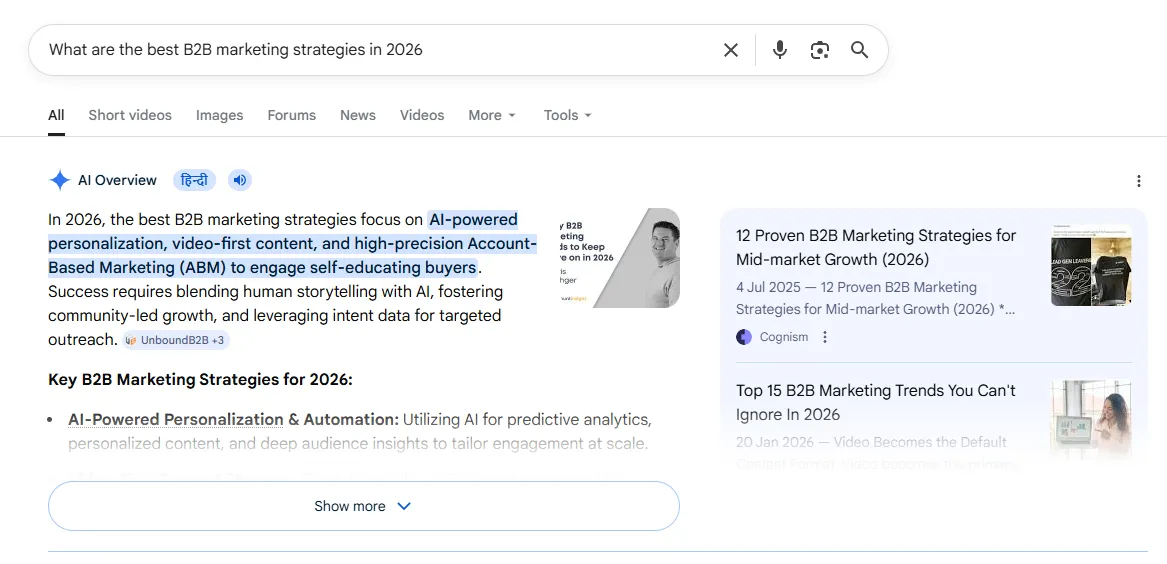
“What are the best B2B marketing strategies in 2026?”
AI tools perform a scan across all trusted sources on the search engine.
They basically look for:
- Clear explanations
- Credible domains
- Structured logic
- Referenced brands
Source Selection By AI
We’ve analysed several AI research blogs and also some SEO interviews, and have come to a conclusion that AI systems prioritizes:
- High-authority domains
- Pages that have consistent signals from entity
- Fact-based information
- Frequently cited sources
- Structured formatting
Though AI tools are trained on massive datasets, they prefer:
- Clarity over fluff.
- Original insights over repetitive information.
- Specificity over vagueness.
If you produce generic content, it will blend in with others.
Make it add value, to stand out.
GEO Has Hidden Advantages
Several marketers today often overlook:
Even with no user clicks, their brands get exposure.
If AI cites your company repeatedly, you gain:
- Brand familiarity
- Trust signals
- Implied authority
This way, user trust also follows your brand over time.
GEO doesn’t replace SEO.
It acts as a catalyst to your visibility.
AEO (Answer Engine Optimization)
AEO as the name suggests focuses on direct answers.
It gained popularity with:
- Featured snippets
- “People Also Ask” section
- Voice assistants
In 2026, AEO plays a bigger role as AI loves structured responses.
What is AEO in Practice
Powerful AEO strategies include:
- Question-based headings
- Including lists and bullet points
- Schema markup
- Comparison tables
- 40–60 word direct summaries
- FAQ sections
For Instance:
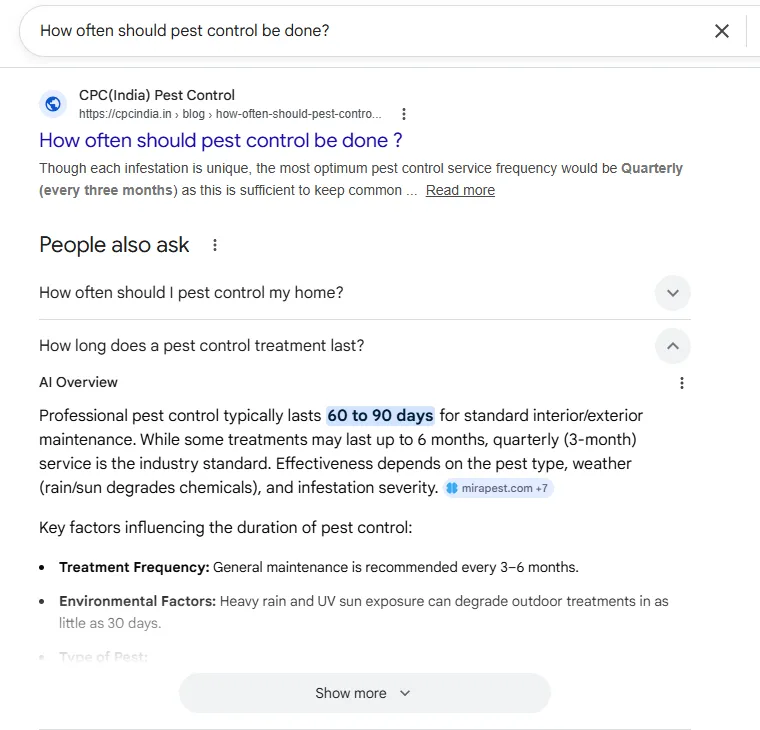
AEO doesn’t require writing a long paragraph, before answering a question. It would structure the content like:
AIO (AI Optimization): The Broader Layer
AIO is philosophical.
The concept requires preparing your brand for AI discovery, which is beyond search engines.
AIO discovery channels include:
- AI chat interfaces
- AI shopping assistants
- AI summarization tools
- AI-powered productivity apps
- Enterprise knowledge bots
AIO requires deep thinking and not only keywords emphasis.
It involves:
- Entity recognition
- Cross-platform credibility
- Structured data
- Knowledge graph presence
- Consistent brand identity
To get your brand discovered by AI, ensure that it appears frequently on:
- News sites
- Industry blogs
- Podcasts
- Reviews
- Author profiles
This is how, AI system will recognize it as an entity.
And as we earlier read, entities rank better than isolated pages.
AIO is nothing but developing a machine-readable reputation.
The Shift: From Keywords to Entities
Entities are the major development of modern SEO in 2026.
Search engines and AI models increasingly operate on entity-based indexing.
An entity can be anything, like:
- A brand
- A person
- A product
- A concept
- A location
Instead of matching keywords with user query, algorithms connect relationships. It helps algorithms provide more value to the user.
Let us study the following example:
“HubSpot” is connected to CRM, marketing automation, inbound marketing, SaaS, etc.
If this brand becomes an entity associated with specific topics, it gains durable authority.
That’s why:
- Consistent naming matters.
- Structured data is critical.
- Author profiles matter.
- Wikipedia or Wikidata presence matters.
This is how there is intersection between the different concepts: SEO, GEO, and AIO.
Zero-Click Search
Zero-click searches are increasing.
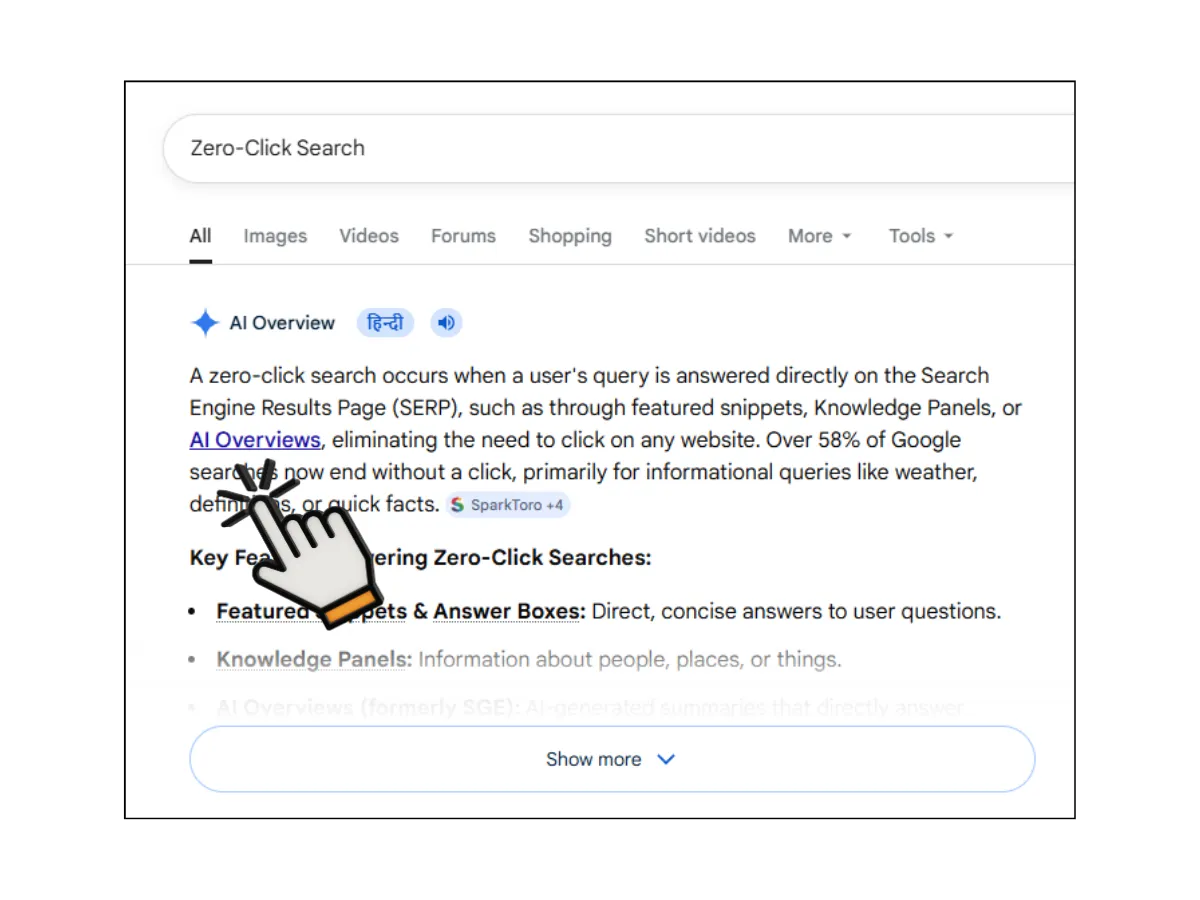
Users are gettinga answers without visiting different websites.
Sounds threatening, right?
Consider it the other way round.
Make your brand appear in featured snippets or AI summaries, and you will gain:
- Visibility
- Recognition
- Authority positioning
Tracking KPIs is what is suggested. Instead of tracking only traffic, track:
- Brand mentions
- Direct traffic growth
- Assisted conversions
- Branded search volume
Visibility influences demand. Even if the number of clicks decreases.
Content Quality in 2026 Is What Matters!
AI-generated content is everywhere.
Low-quality articles are found everywhere on the internet, since ages.
Algorithms are changing with the change in concepts.
AI systems prefer content that shows:
- Experience
- Uniqueness
- Case studies
- Real-world examples
- Contrarian viewpoints
If you are simply writing a blog by taking information from 10 other blogs, it is not going to help.
Ensure that it includes:
- Original frameworks
- Clear analysis
- Real business implications
So that it becomes reference-worthy.
Quality is no longer optional. Brands need to live by it
What Top Industry Experts Are Emphasizing
Industry experts agree on a multiple themes listed below:
Topical Depth Beats Content Volume
Create ten deep articles around your selected topic, and it will simply outperform fifty shallow ones.
AI Overviews Reward Clarity
To win the AI realm, focus on simple language and clean formatting. AI platforms look for easy to read content with easily readable formatting.
Brand Authority Is Becoming Central
AI models rely heavily on recognizable platforms. Build your brand authority by gaining mentions on reputed domains.
Utilize Structured Data
Schema markup enhances machine understanding of the website. It makes brand discovery easy, beyond search results.
Human Expertise Wins
Author credentials influence trust signals. Both users and modern systems look for authority and human expertise to ensure that the content adds value.
One thing is clear:
The fundamentals still matter. However, strategies to execute, must be sharp.
How They All Work Together: Real-World Example
Layer | Role in the Strategy | What It Actually Does | Example Action (Pest Control Business) | Primary Goal | How It Supports Other Layers |
SEO | Foundation layer | Helps search engines crawl, index, and rank your website | Target keywords like “pest control near me” or “termite treatment [city]” and build local authority | Rank in Google positions 1–3 | Creates authority signals that AI systems later trust and cite |
AEO | Answer layer | Structures content to deliver direct, clear answers | Publish FAQs like “How often should pest control be done?” using FAQ schema | Win featured snippets and PAA boxes | Clean answer formatting improves AI extraction and GEO citations |
GEO | AI citation layer | Positions content as a trusted source inside AI responses | Publish deep guides such as “Complete Pest Control Guide 2026” | Get mentioned in ChatGPT, Perplexity, Gemini answers | Relies on SEO authority and AEO clarity to earn citations |
AIO | Unified visibility system | Aligns SEO, AEO, and GEO across all discovery platforms | Optimize structured data, test brand visibility across AI tools | Total discovery across search + AI ecosystems | Connects all strategies into one scalable growth system |
SEO vs GEO vs AEO vs AIO: A Strategic Comparison
Distinction Basis | SEO | GEO | AEO | AIO |
Core Goal | Ranking on search results | Citations in AI answers | Offers direct answers | Optimize for AI ecosystem |
Focus | Traffic | Visibility in AI summaries | Voice search & Snippets | AI visibility in the long run |
Key Tactic | Clustering content | Building authority through clairty | Structured FAQs section | Building entities |
Time Horizon | Medium to long term | Growing importance | Tactical | Strategic future-proofing |
The different concepts are not rivals of SEO. Rather they are layers.
What Matters The Most in 2026?
After going through the different concepts, here’s the honest answer:
The winner in 2026 is not a tactic.
It’s authority.
SEO provides structure. GEO provides AI visibility. AEO improves answer extraction. AIO prepares you for long-term machine-driven discovery.
But none of them work without credibility. And working for only one will not take your brand anywhere.
You cannot hack credibility or buy it. Work on building it.
Conclusion
The debate around SEO vs GEO vs AEO vs AIO sounds complex. But in reality it is simple.
Search is evolving into AI-driven discovery. Though ranking exists in the realm. Referencing from authoritative domain matters, and what matters the most is being referenced.
User trust matters too.
If your strategy integrates strong SEO fundamentals with AI-aware formatting and brand authority building, you are future-proof.
If you chase shortcuts, you will struggle.
In 2026, the brands that win are not the loudest.
They are the clearest, the most useful, and the most credible.
That’s what actually matters.