A website is a big investment. If it does not appear on Google, that investment loses its value and so does the time spent building it.
Google does not look at a website the way a normal visitor does. A person may visit your website and quickly decide whether it looks good, loads fast, and answers their question. Google looks deeper. It checks whether your website is correctly set up and eligible to appear in search results by measuring many things: your pages, your structure, your content, your trust signals, your user experience, and whether your website deserves to show up when someone searches for a related product or service.
That is why SEO is no longer only about adding keywords to a page. Today, Google watches many signals together.
Before we jump to main topic, you should first understand the search intent in SEO. It’s very important to understand your audience.
The Importance of Search Intent in SEO
One term that every business or marketer need to prior is search intent. Search intent is the reason behind a search.
When someone types a query into Google, their search intent can be different.
Google broadly groups search intent into four types:
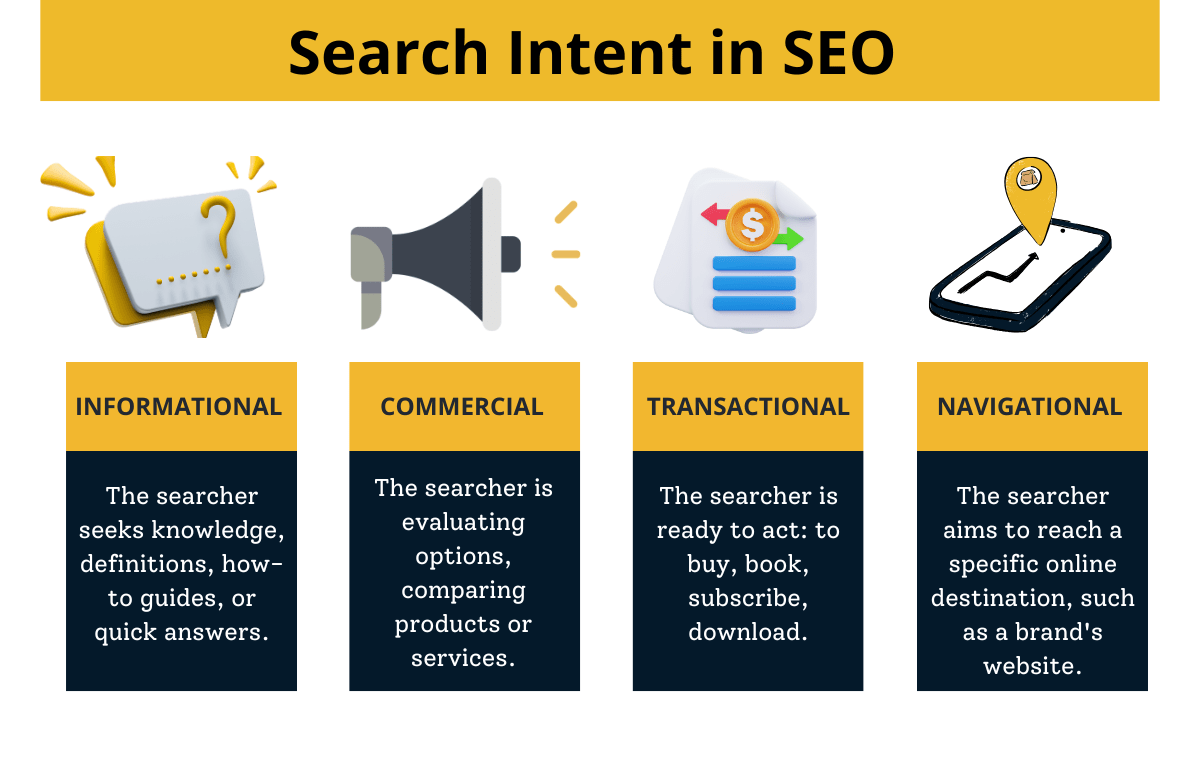
Informational Intent: The searcher seeks knowledge, definitions, how-to guides, or quick answers.
Commercial Intent: The searcher is evaluating options, comparing products or services, reading reviews, and assessing value before making a decision.
Transactional Intent: The searcher is ready to act: to buy, book, subscribe, download, or visit a physical location.
Navigational Intent: The searcher aims to reach a specific online destination, such as a brand’s website, a login page, or a product catalog.
If your page does not match the intent, rankings and traffic will not mean much.
Modern SEO starts with asking better questions.
- What does the customer want to hear?
- What problem do they solve?
- What are their concerns about contacting a company?
- What proof do they need to believe you?
When content answers these questions clearly, it becomes more useful for users and easier for Google to understand.
This direction is also supported by Google’s helpful content guidance. “Google’s systems are designed to surface helpful, reliable, people-first information, not content that’s primarily designed to manipulate search rankings,” Google says.
Here we will discuss all the SEO terms and words that are most essential in search engine optimization.
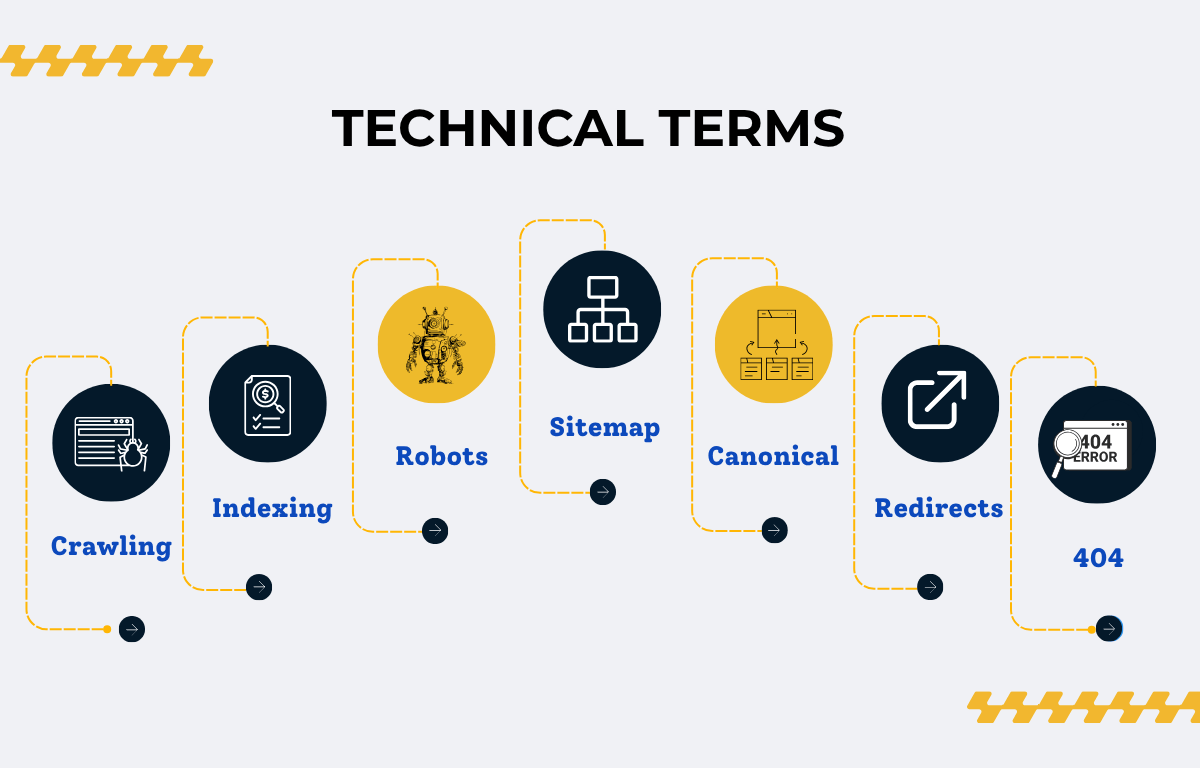
Technical SEO Terms
Technical SEO sits at the heart of every strong SEO strategy. These are not outdated terms. They are the foundation Google uses to discover, understand, and evaluate your website.
A proper technical checklist helps you find and fix the issues that are quietly holding back your website’s visibility and user experience.
SEO Term | What is it? | Why Your Website Should Care |
Crawling | This is when Google’s bots come to your website and move through your pages to see what is available. | If important pages are hard to reach, Google may miss them, and those pages may not get proper search visibility. |
Indexing | After Google finds a page, it decides whether to save it in its search database. | A page that is not indexed has very little chance of appearing when customers search for your services. |
Robots.txt | This file gives basic instructions to search engines about which parts of the website they should or should not access. | One wrong setting can accidentally keep useful pages away from Google, even if the content is good. |
Sitemap | A sitemap works like a simple page guide for search engines, showing the important URLs on your website. | It helps Google understand your website layout and find key pages faster, especially on larger websites. |
Canonical Tag | This tag tells Google which page should be treated as the main version when similar pages exist. | It reduces confusion when two pages look alike and helps protect the value of the main page. |
301 Redirect | This is a permanent move from an old URL to a new URL. | It helps visitors and Google reach the right page when a URL changes, without wasting the page’s existing SEO value. |
404 Error | This appears when someone opens a page that is missing, deleted, or no longer available. | Too many missing pages can frustrate users and make the website look poorly maintained. |
These terms may sound technical, but they affect real business results. If Google struggles to crawl and index your website, your best service pages may never get the visibility they deserve. If your site has broken links, messy redirects, duplicate pages, or blocked pages, users and search engines both face confusion.
Google’s own guidance for AI features also confirms that the basics still matter. To appear in AI Overviews or AI Mode as a supporting link, a page must be indexed, eligible to show a snippet, and follow Google’s technical requirements.
Also discover Technical SEO Tools.
On-Page SEO Terms
Once Google can access your website, we need to make sure that website pages and posts primarily serve users rather than crawlers. This is where on-page SEO becomes important.
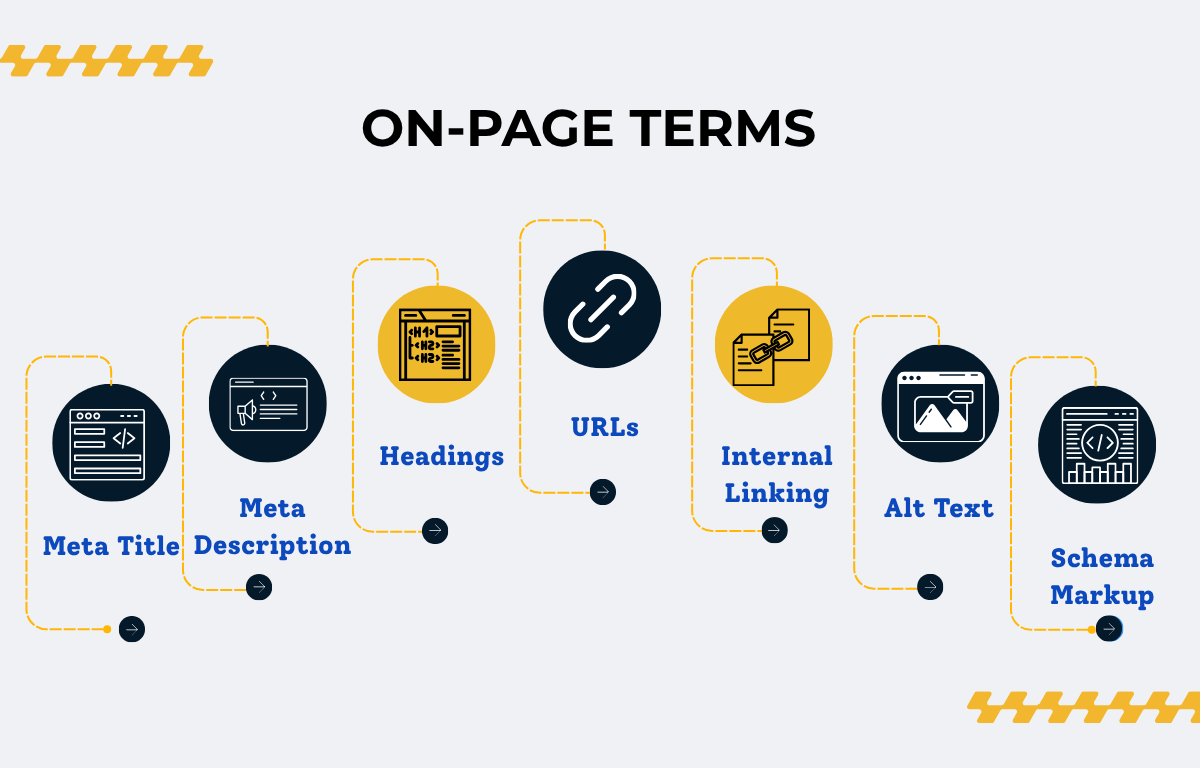
This section has a checklist for on-page elements that must be considered when working on website optimization.
On-Page SEO Element | What We Review | Why It Matters |
Meta Title | We check whether the page title clearly tells users and Google what the page is about. | A strong title can improve search understanding and make people more likely to click. |
Meta Description | We review whether the description gives a clear reason to visit the page. | It helps users quickly decide if your page has the answer, service, or solution they need. |
Headings | We check whether the page is divided into clear sections that are easy to follow. | Good headings make the content easier to read and help Google understand the main points on the page. |
URL Structure | We review whether the page link is clean, simple, and related to the topic. | A clear URL looks more trustworthy and helps both users and search engines understand the page context. |
Internal Linking | We check whether important pages are connected naturally across the website. | Internal links guide visitors to useful pages and help Google discover the relationship between your content. |
Alt Text | We review whether important images have meaningful descriptions. | Clear image descriptions support accessibility and help search engines understand visual content better. |
Schema Markup | We check whether structured data is added correctly and matches what users can actually see on the page. | It gives search engines extra context about your content, business, services, FAQs, or articles. |
User Experience Terms
UX/UI and SEO are the dots connecting each other. A website may rank well, but if it loads slowly or does not give users a good experience, that traffic will not turn into results. This is why we do not see SEO and website experience as separate things. If SEO brings visitors but the website does not build confidence, the business still loses.
These are the main UX elements that help improve SEO:
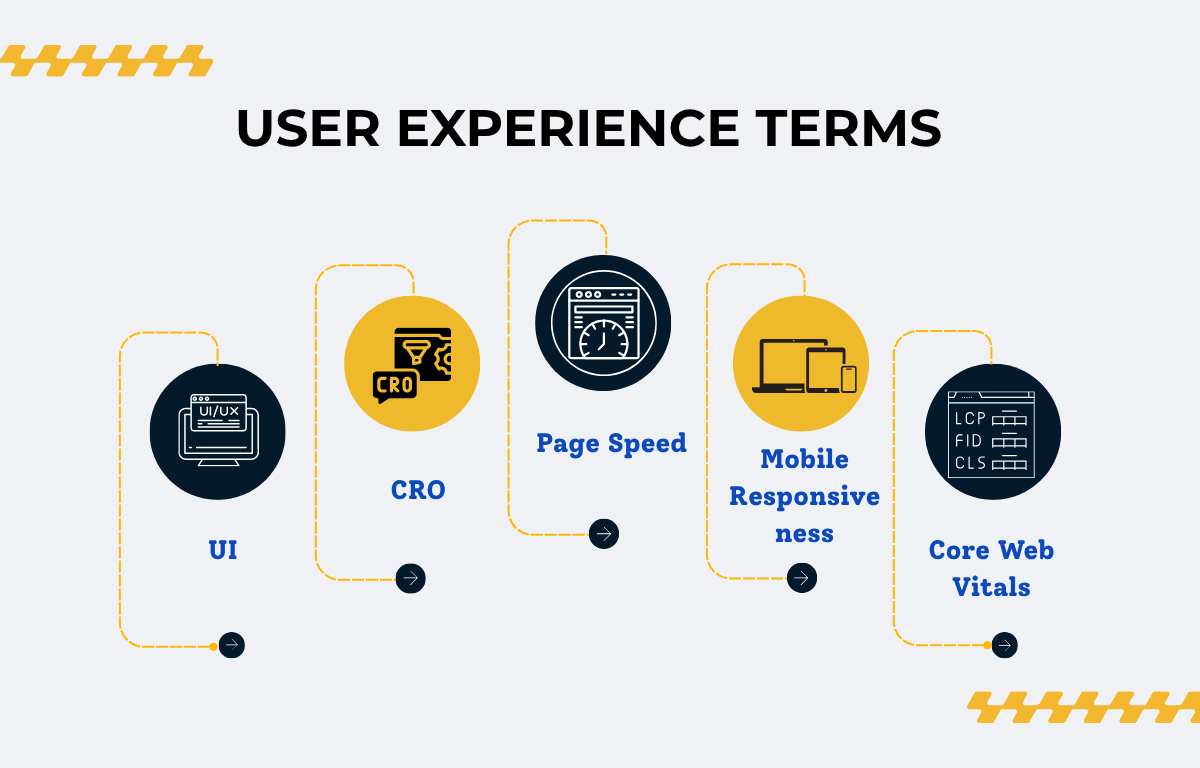
UX Element | What It Means for Visitors | Why It Matters for SEO and Leads |
UI | UI is the way your website looks, feels, and guides people from one section to another. | When the layout is clear, visitors understand your business faster and feel more confident staying on the page. |
CRO | CRO means improving the website so more visitors take action, such as calling, filling a form, booking, or buying. | SEO can bring people to your website, but CRO helps turn that traffic into real enquiries and customers. |
Page Speed | Page speed shows how quickly your website opens and becomes usable for visitors. | Slow pages make people leave early, while faster pages create a smoother experience and protect potential leads. |
Mobile Responsiveness | This means your website adjusts properly on mobile phones, tablets, and different screen sizes. | Since many customers search from mobile, your website must be easy to read, scroll, and use on smaller screens. |
Core Web Vitals | These are Google’s experience signals that look at loading speed, page response, and visual stability. | They help show whether the page feels smooth and reliable when someone actually uses it. |
Authority Terms
Authority terms calculate about how trusted and known your website is and signal to search engines to view your site as more credible and relevant.
Authority is measured by
- Quantity
- Quality
- Relevance
- Prominence
Today authority is more than just backlinks, it’s built around Google’s E-E-A-T guidelines.
To get valuable trust signals, we need to focus on authentic reviews, helpful content, expert-written content, case studies, author bio, business profiles, media mentions, local citations, and consistent brand information.
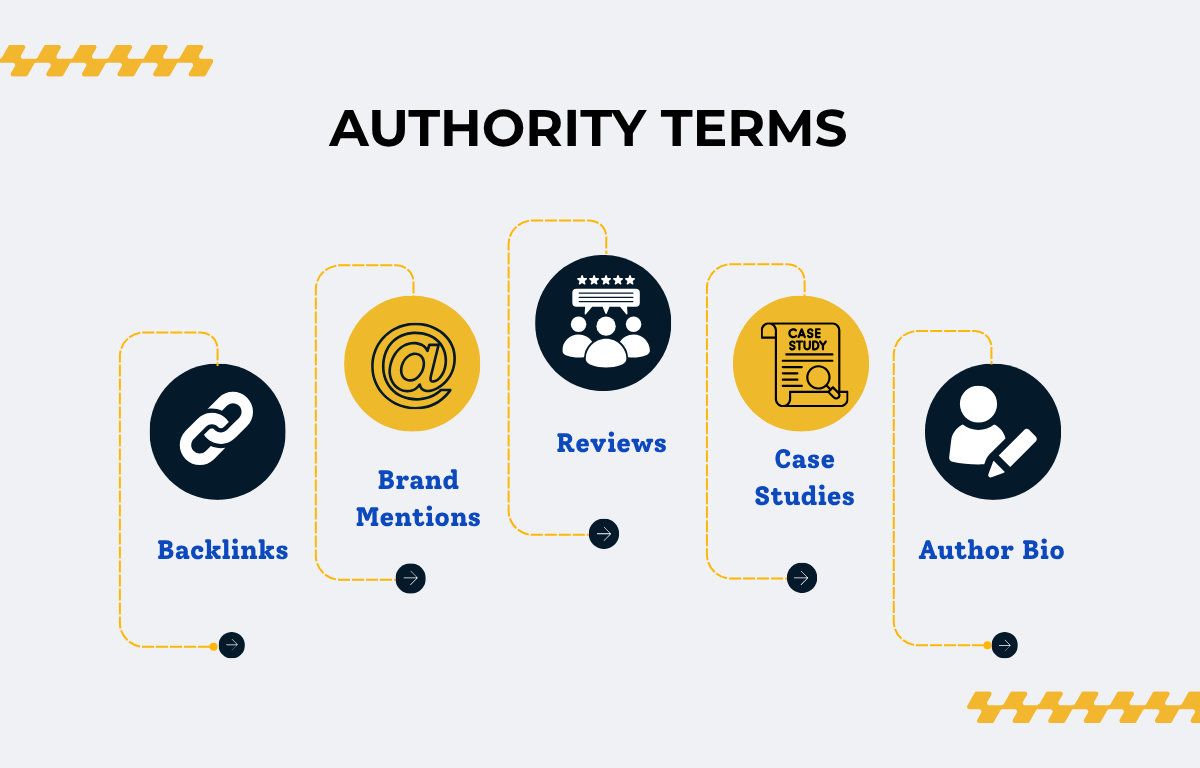
Trust Signal | What It Shows | Why It Matters for Google and Customers |
Backlinks | Backlinks show that other websites are pointing people toward your content or business. | When links come from relevant and reliable websites, they can support your website’s authority and make your brand look more credible. |
Brand Mentions | Brand mentions happen when people, websites, directories, forums, or media pages talk about your business online. | Even when there is no direct link, repeated brand mentions can help build recognition and show that your business has a real online presence. |
Reviews | Reviews show what real customers think about your service, product, or overall experience. | Strong and genuine reviews help new customers trust you faster and also support local visibility. |
Case Studies | Case studies explain how your business helped a client solve a real problem or achieve a clear result. | They give visitors proof that you can deliver, instead of only saying that you are good at what you do. |
Author or Team Information | This tells visitors who created the content or who is behind the business. | Clear team or author details make the website feel more transparent, expert-led, and trustworthy. |
Consistent Business Details | This means your business name, address, phone number, services, and profiles stay accurate across the web. | Consistency helps Google and customers verify your business more easily, especially for local SEO and service-based searches. |
This is where many old SEO strategies fail. They focus only on links, not reputation. They publish content, but do not show experience. They chase rankings, but do not build trust. In modern SEO, trust is not optional. It is part of visibility.
AI SEO Terms
Google now uses artificial intelligence (AI) to reshape the SEO industry and redefine its future. After decades of traditional Google search, users are now seeing AI-assisted, more direct results in Google AI Overviews and search experiences that reward clarity, trust, and usefulness.
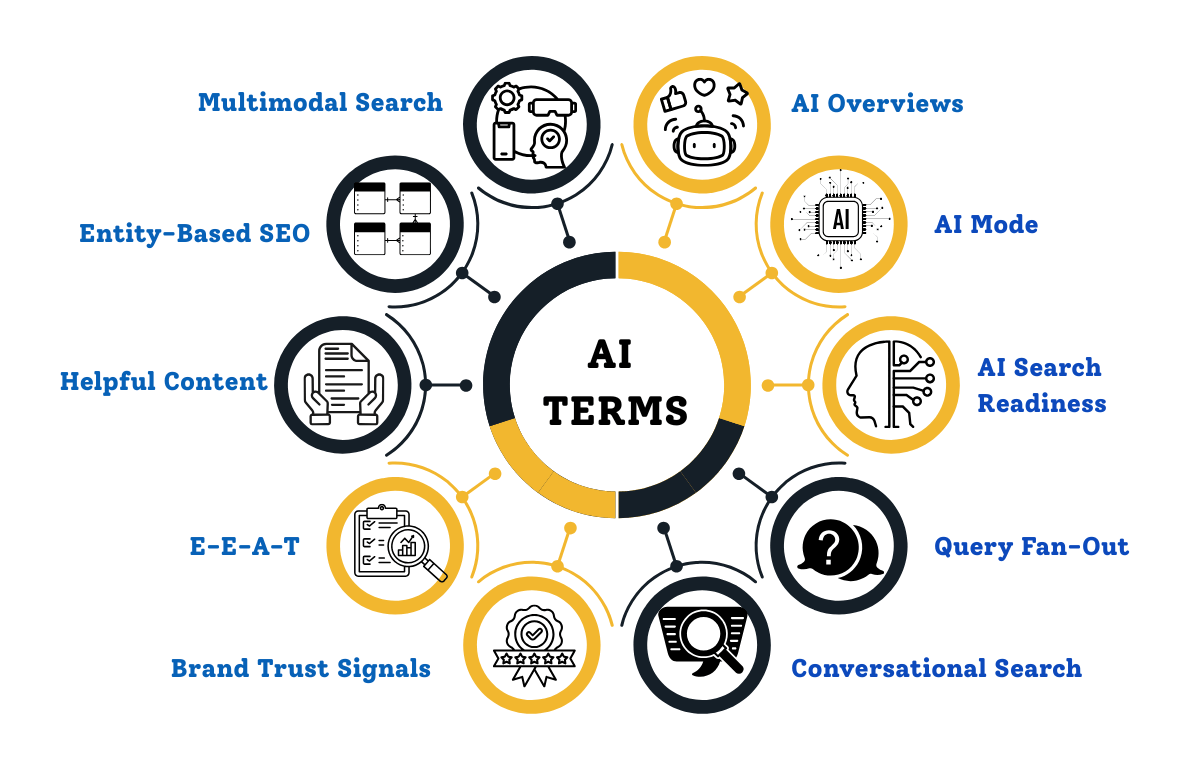
Google has said AI Mode supports advanced reasoning, multimodality, follow-up questions, and query fan-out, where Search breaks a question into subtopics and explores multiple related queries.
What’s changed with AI in SEO?
New SEO Term | What It Means in Our Words | Why It Matters for Modern SEO |
AI Overviews | These are Google’s AI-assisted answers that appear for some searches and may include links to websites that support the answer. | If your content is clear, useful, and reliable, it has a better chance of being understood as a helpful source in AI-led search experiences. |
AI Mode | AI Mode is Google’s more advanced search experience where people can ask detailed questions and continue the search with follow-up prompts. | Websites now need to explain topics with more depth, because users are not always searching with short keywords anymore. |
AI Search Readiness | This means your website is prepared for both normal search and AI-powered discovery through strong content, clean structure, and technical clarity. | A website that is easy to crawl, index, understand, and trust is better positioned for the way search is moving. |
Query Fan-Out | This is when Google explores different parts of a broad question to understand the full topic better. | Your pages should cover a subject properly, including related questions and user needs, instead of depending on one exact keyword. |
Conversational Search | This refers to searches that sound more like real questions or natural conversations. | Your content should speak the way customers actually ask, compare, and decide, not like a page written only for search engines. |
Multimodal Search | This is search that can involve more than typed words, such as images, videos, voice, or camera-based searches. | Strong visuals, helpful image descriptions, useful videos, and clear page context can make your website easier to understand in different search formats. |
Entity-Based SEO | This means helping Google connect your business with your services, locations, people, expertise, and related topics. | When your brand information is clear and consistent, search engines can understand your business identity and topical relevance better. |
Helpful Content | This is content created to solve a real user problem, answer a real question, or guide someone toward a better decision. | Content that genuinely helps people builds stronger trust and performs better than content written only to chase rankings. |
E-E-A-T | E-E-A-T shows whether your content reflects real experience, expert knowledge, authority, and trust. | It helps visitors feel confident that the information is coming from a reliable business or knowledgeable team. |
Brand Trust Signals | These are the proof points around your brand, such as reviews, case studies, mentions, business details, expert profiles, and client results. | They reduce doubt, strengthen credibility, and help people feel more comfortable choosing your business over another option. |
These are the terms businesses and SEO agencies should not ignore. They show where SEO is moving. Google is becoming better at understanding meaning, usefulness, trust, and context. That means thin content, keyword stuffing, copied blogs, and random backlinks are becoming weaker strategies.
What This Means for Business Owners
If you own a business, you do not need to memorize every SEO term. But you do need to understand what they all point toward. Google wants to understand three things clearly.
- First, it wants to know whether your website can be found and processed properly. This is where crawling, indexing, robots.txt, sitemap, redirects, canonical tags, and technical SEO matter.
- Second, it wants to understand what your pages are about and whether they match the user’s search intent. This is where meta titles, headings, content depth, internal links, schema, and helpful content matter.
- Third, it wants to understand whether users can trust your business. This is where E-E-A-T, reviews, backlinks, brand mentions, case studies, local signals, and reputation matter.
When these three areas work together, your website becomes stronger.
- It becomes easier for Google to understand.
- It becomes easier for customers to trust.
- It becomes easier for AI-powered search systems to connect your content with the right questions.
Final Thoughts
SEO terms are signals that help Google understand your website. If your SEO strategy is still only focused on keywords and backlinks, it is time to upgrade.
Modern SEO needs technical clarity, useful content, strong trust signals, better user experience, and AI search readiness.
At Strivers Edge, we help businesses move from old SEO to AI SEO growth.
Want to know how Google sees your website today? Talk to our SEO expert and let us review the signals that matter most for your growth.

Mandeep Singh is a Digital Marketing consultant at Strivers Edge, renowned for driving first-page Google rankings for businesses in competitive industries. With more than 10 years in the industry, he specializes in digital and content marketing.