If you have ever read an SEO proposal and quietly wondered what half of it meant, this blog post is the answer. You do not need to become an SEO expert to run a moving company, but you need to understand SEO vocabulary to tell whether the person you are paying is doing good job or not.
This guide will help you understand what each term means for your moving business, whether you want to rank for organic search, win the map results through your Google Business Profile, or simply want to learn why your website isn’t appearing in Google search.
Understanding SEO terminology (SEO Terms) for a mover’s website is the first step to knowing if your website is ready to dominate of the world of digital marketing.
Each term comes with a plain English definition, an explanation of how it affects your moving business, and the mistake movers most often make.
The terms are organized by group rather than alphabetically.
Here is the order:
- How Customers Find You in Search Results
- Whether Google Can Crawl, Read and Index Your Pages
- Content & Authority Build Up.
- AI Search and Answer Engines
- Tracking
Google makes a similar point in its SEO Starter Guide: search engines have to understand your pages, and people need a reason to click. There are no secret strategies that will put your site at the top. Anyone promising that is either selling you something or planning to use black hat tactics that will cost you later.
Terms About How Customers Find You in Search Results
SEO
SEO stands for search engine optimization. It involves helping Google understand your website so customers can find you. For a moving company, SEO covers everything your business needs to be visible: Google Business Profile, service pages, city and route pages, website speed, reviews, links, and tracking. Each part affects the others.
Local SEO
Local SEO covers searches where user search with location terms like “movers near me” or “office movers in Austin” etc.
Google says local results depend on three things: relevance, distance and prominence. That means an accurate GBP profile, business category, current phone and hours, and a real reputation. Google explains this in its local ranking guide. Our local SEO services will help you optimize everything above.
3 Map Pack
The Map Pack is the block of three business listings Google shows above the organic results for local searches. For a moving company it is often the most valuable position on the page, because it generates direct phone calls, direction requests and messages, along with your rating, hours and location shown right in the result.
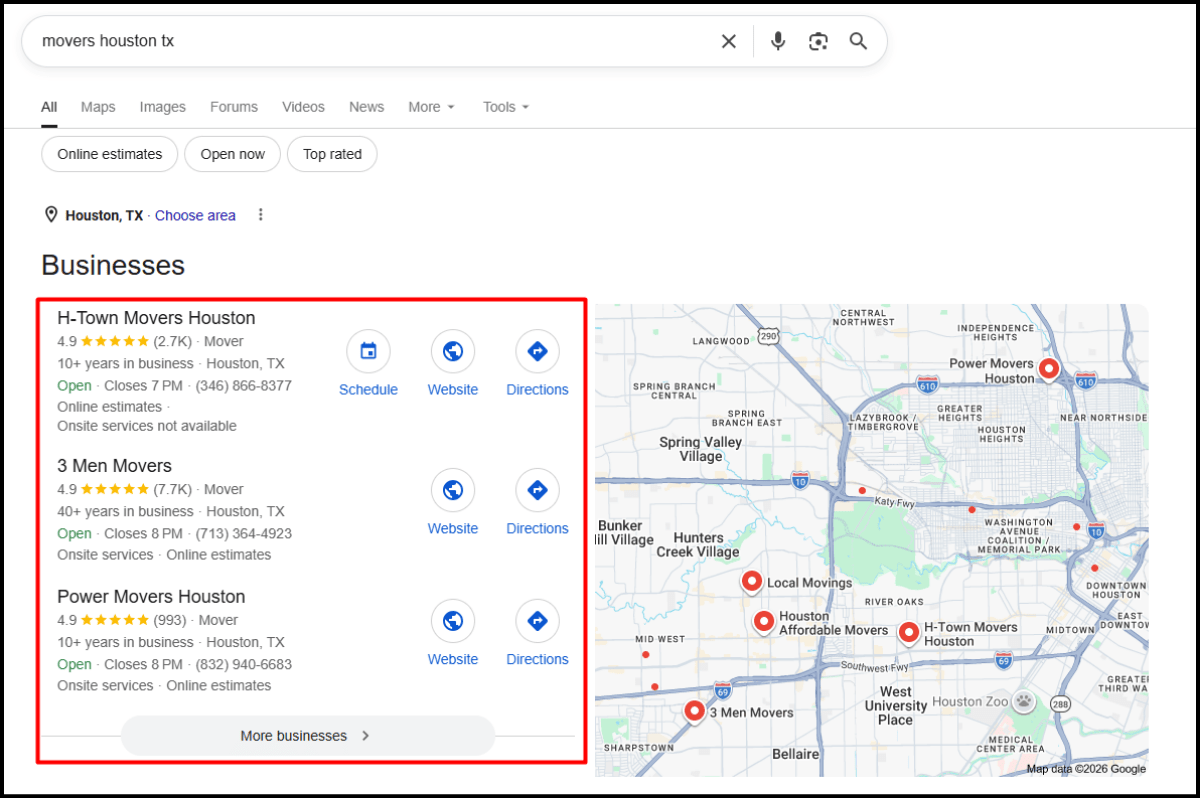
Ranking fourth means you are invisible unless someone taps to expand the list. Most people do not.
Google Business Profile
Your Google Business Profile is the free listing that controls how you appear on Google Search and Google Maps. It holds your name, category, hours, phone number, website, service area, photos and reviews.
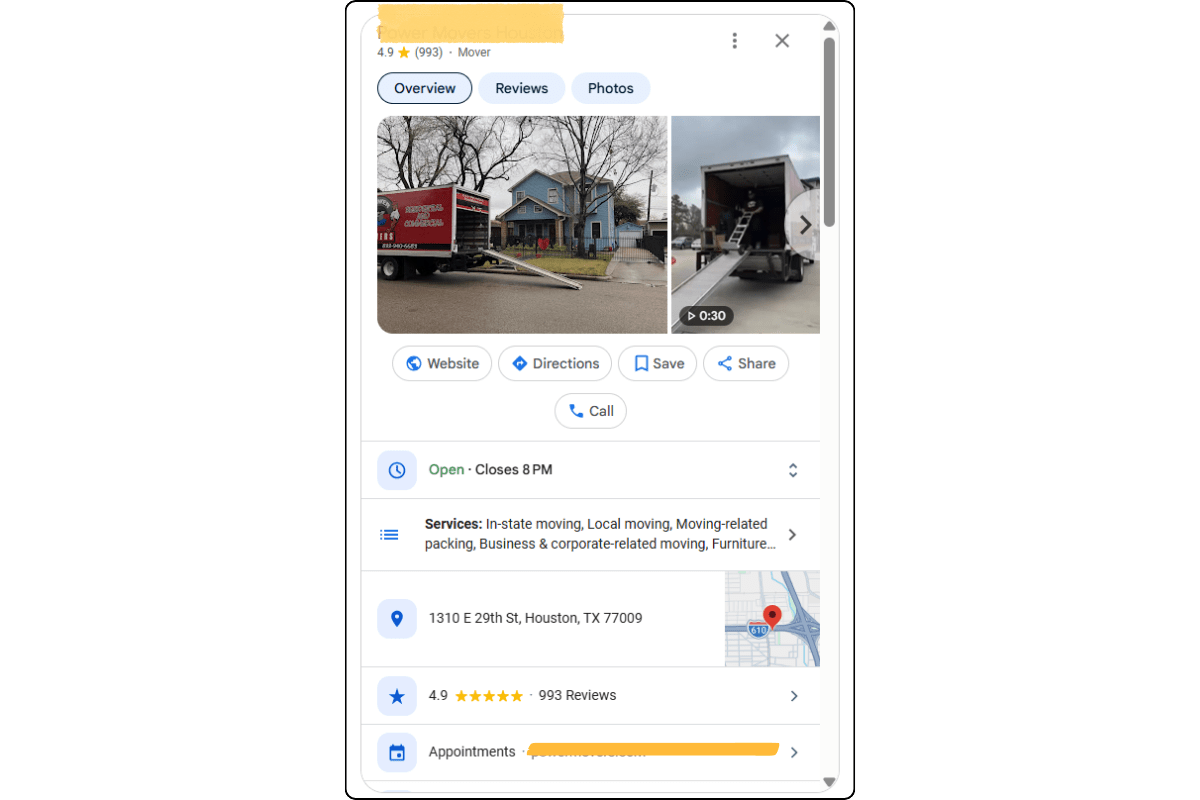
Being accurate matters more than being listed. Google’s Business Profile guidelines say your profile must show the business as it really is.
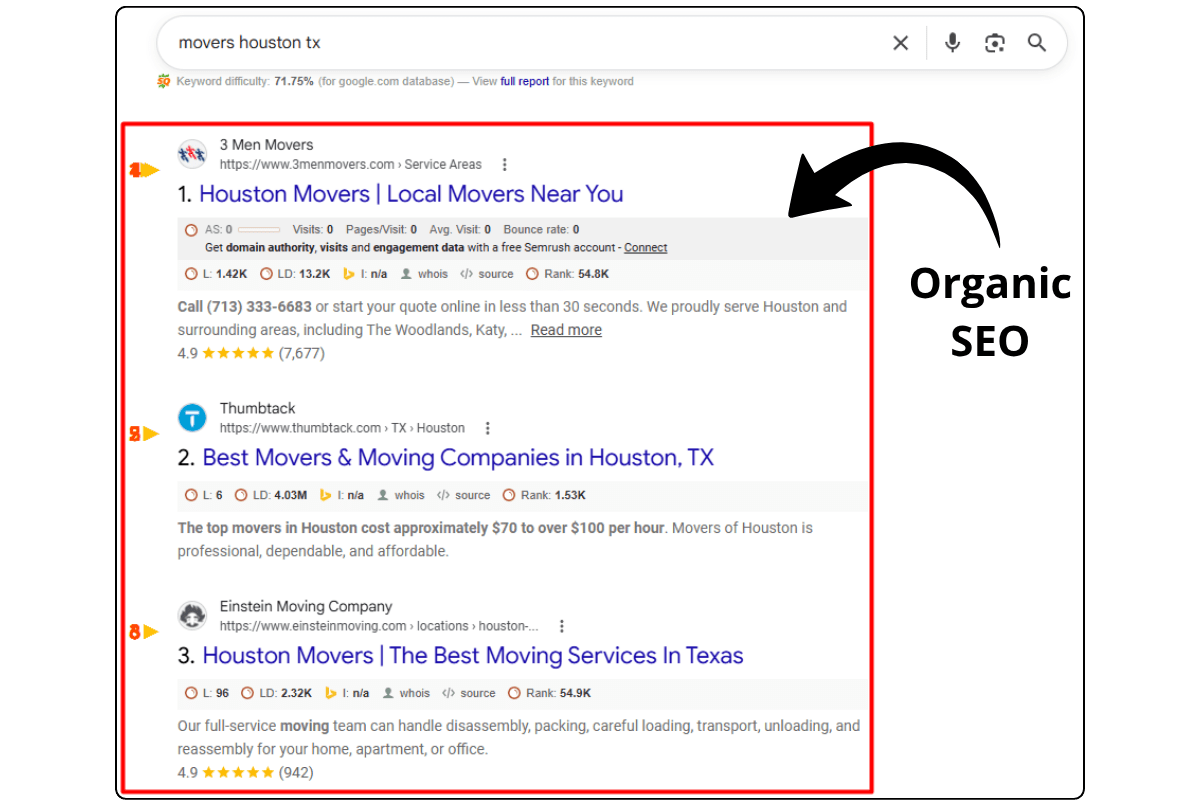
Organic Results
Organic results are the normal search listings below the ads and the map results. Google picks them based on what it thinks is best for the searcher. You cannot pay for these positions, which is the whole point of doing SEO.
Keywords
A keyword is a word or phrase people type into Google.
Do not build a page around a keyword until you know what the searcher wants. Look at these four:
- Movers Dallas
- Dallas to Houston movers
- Office relocation checklist
- Moving quote
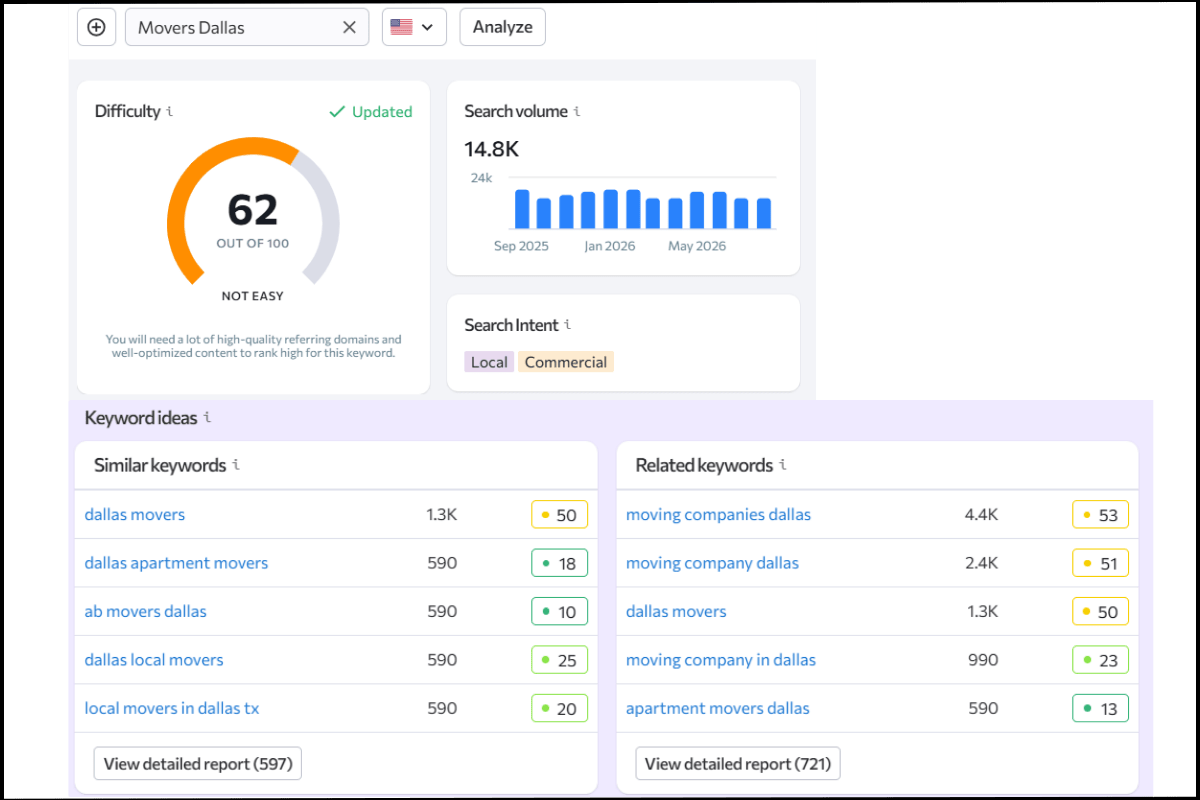
All 4 mention moving. They need four different pages, because they come from four different people at four different points in the decision. Different cities, different stages, different buyers.
Search Intent
Search intent is what someone is actually trying to do when they type a query, as opposed to the words they happen to use.
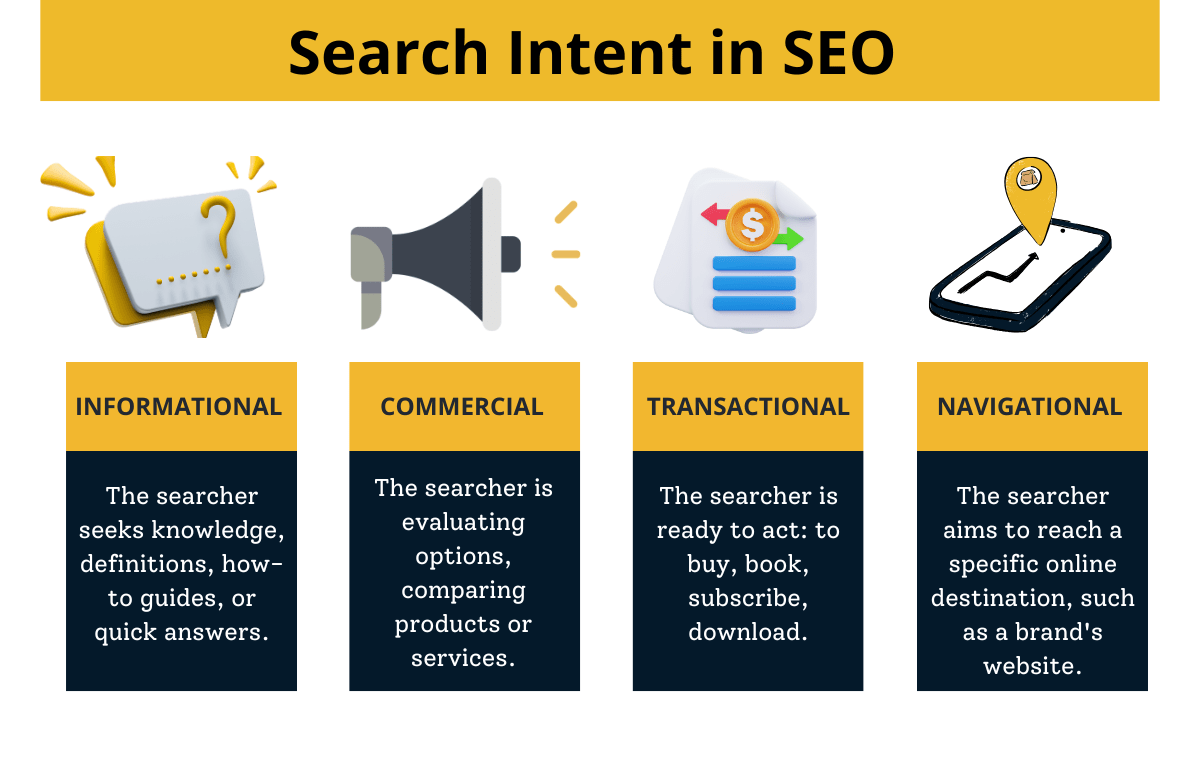
The 4 standard categories are informational, navigational, commercial and transactional. For movers it is worth adding a fifth, because so much of your traffic is location-driven:
- Informational: someone researching how to pack a kitchen
- Navigational: someone looking for your company by name
- Commercial: someone comparing three movers before deciding
- Transactional: someone ready to request a quote
- Local: someone who needs a mover in a specific place, right now
Terms About Whether Google Can Read Your Website
Crawling
A crawler or bot is software that visits web pages and reads them for a search engine. It’s important that they reach money pages of the website. Google’s crawler is called Googlebot and it follows links from page to page, collects what it finds, and sends it back to Google for search engine results.
SEO starts here. If a crawler cannot reach your pages, they cannot be indexed. Without indexing, customers will never see them in search results, no matter how good the content is.
Check that your money pages, meaning your quote page, your service pages and your city pages, are reachable by following links from your homepage.
Indexing
Indexing is the step after crawling, where Google stores your page and makes it eligible to appear in search results.
Being crawled is not the same as being indexed. Google can visit a page, decide it adds nothing, and leave it out. That happens a lot with thin city pages.
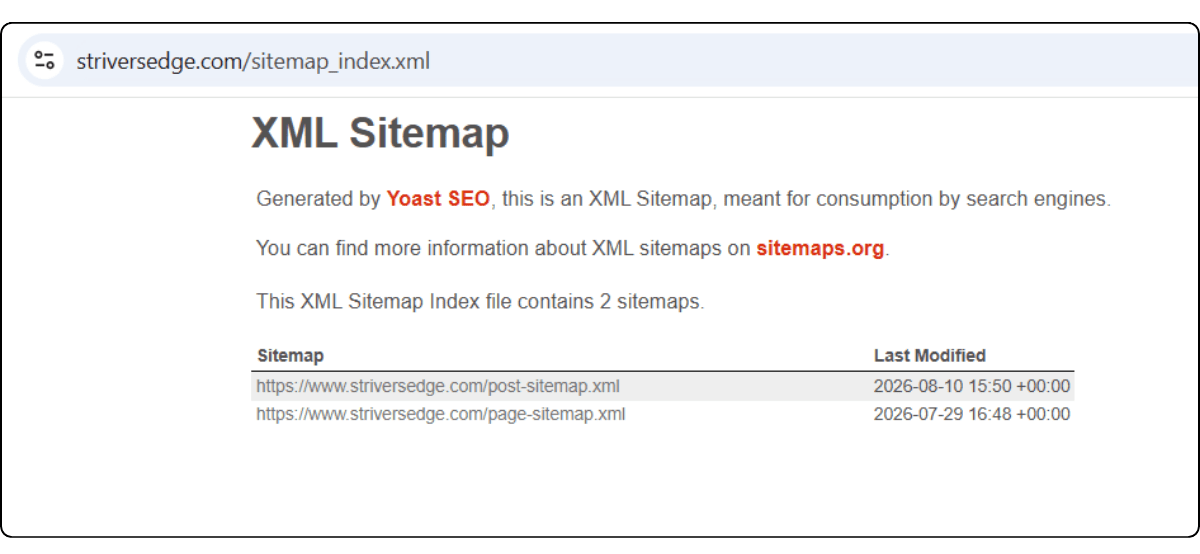
Sitemap
A sitemap is a file that lists the pages and posts that matter on your site and helps Google find them. It does not force Google to crawl them or index them. Google’s sitemap guide says this clearly.
Robots.txt
Robots.txt is a file at the root of your site that tells crawlers which URLs they may fetch. It controls crawling, not indexing, and that difference trips people up constantly.
A page you block in robots.txt can still turn up in search results if another site links to it. Google will show the URL without a description, because it was never allowed to read the page.
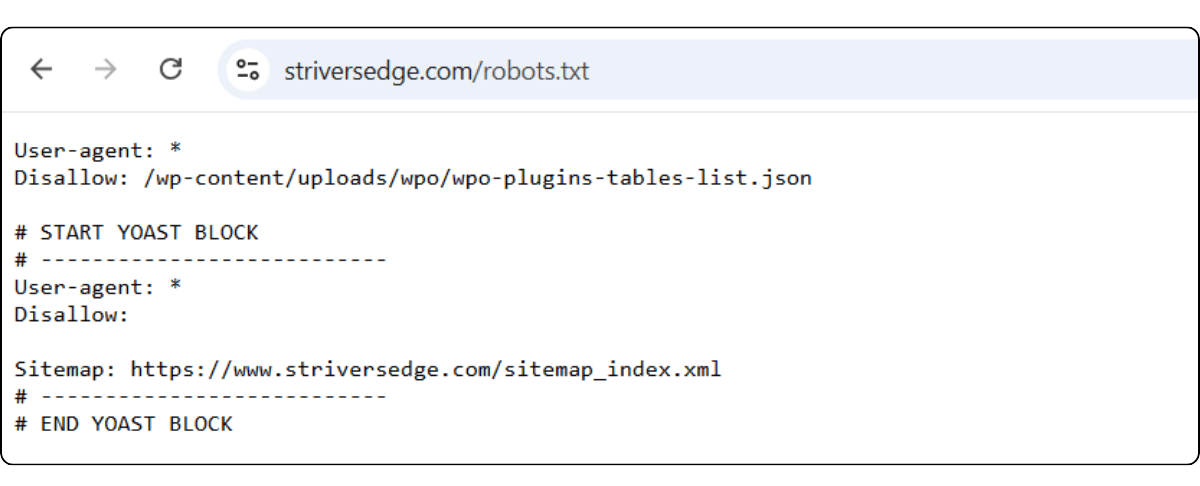
To keep a page out of search results, use a noindex meta tag or an X-Robots-Tag header instead. Google does not support noindex inside robots.txt. Do not do both at once either: if robots.txt blocks the page, Googlebot cannot fetch it, so it never sees the noindex, and the URL stays indexable.
For anything genuinely private, like admin logins or payment pages, use a password. Robots.txt is a public file, so listing your sensitive URLs in it just tells people where to look.
Canonical Tag
A canonical tag tells Google which page you prefer when two pages are the same or almost the same. Use it when the same page can be reached through different URLs.
Movers hit this most often with tracking parameters on ad landing pages and with city pages that duplicate a parent service page.
301 Redirect
A 301 redirect sends visitors from an old URL to a new one and tells Google the move is permanent. Use it wisely when a page moves, when you merge two pages, or when you rebuild your site.
Send each old page to the closest matching new page. Do not send every old page to your homepage, because Google treats that as a soft 404 and you lose whatever the old page had earned. We wrote up the full process in how to migrate a local website without losing SEO. Google’s redirect guide explains how it treats them.
Structured Data (Schema)
Structured data is code that tells search engines what your pages are about. For a moving business, the useful types are Organization, LocalBusiness, BreadcrumbList and BlogPosting.
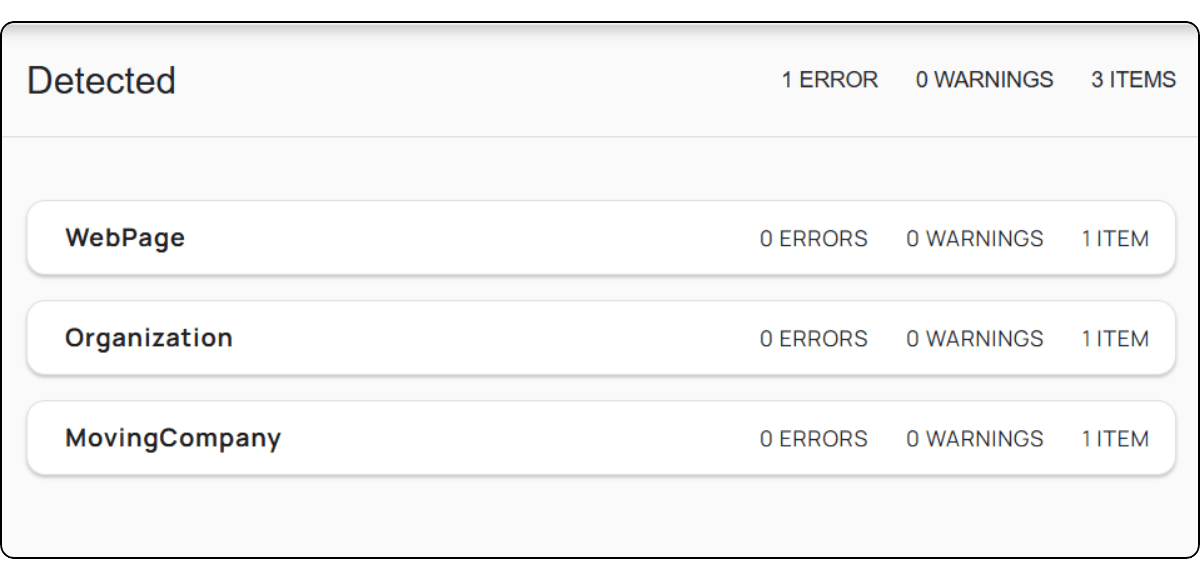
Schema.org also has a MovingCompany type, which sits under LocalBusiness and is more specific than the generic option most SEO agencies use.
JSON-LD
JSON-LD is the format most websites use to add structured data so search engines can read it without having to interpret your page layout.
Core Web Vitals
Core Web Vitals are three scores that measure how your page loads.
- LCP measures how fast the main content loads.
- INP measures how quickly the page responds when someone taps or clicks.
- CLS measures how much the page jumps around while loading.
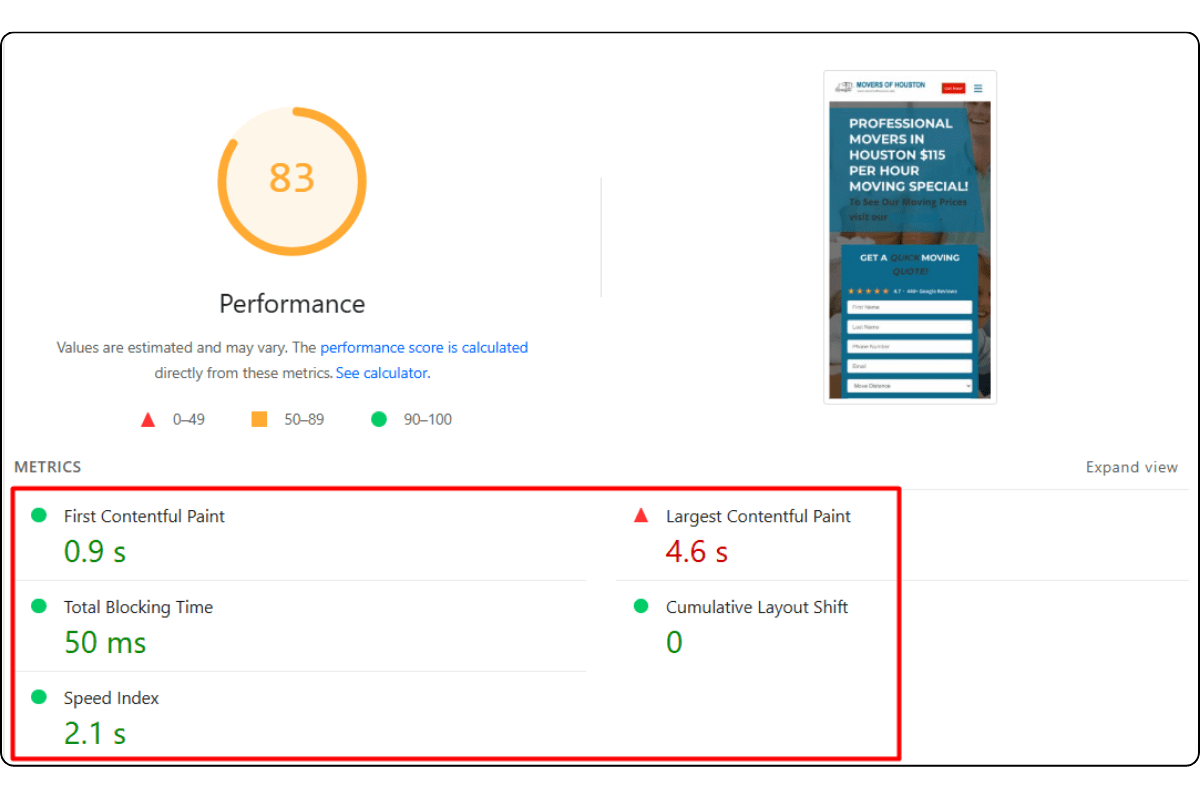
Google’s targets are 2.5 seconds or less for LCP, 200 milliseconds or less for INP, and 0.1 or less for CLS. The Web Vitals guide from the Chrome team keeps these current.
Most moving sites fail on LCP because of oversized hero photos of trucks.
Alt text
Alt text is a short written description of an image so Google can understand what the image shows. Describe what is actually in the photo. “Two crew members carrying a sofa down external stairs in [neighborhood]” beats normal alt text like “moving company services”.
Meta Title and Meta Description
The meta title is the clickable headline Google shows in search results and meta description is the short summary underneath it.
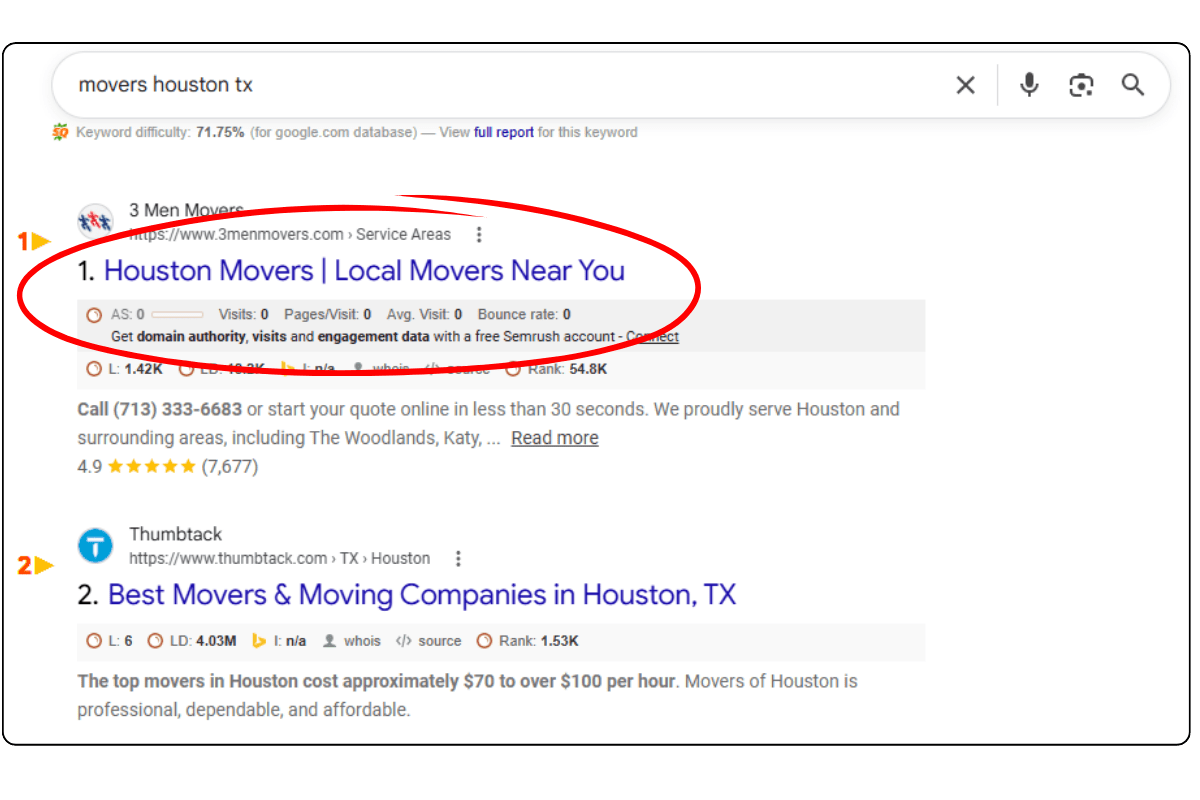
The title tag can influences ranking but description does not. Both tags heavily influence whether anyone clicks or not, which is why a page can sit at top position won’t get traffic.
Terms About Content, Trust Signals and Authority Building
Service Pages
A service page covers what you provide: local moves, long-distance, office relocation, packing, storage. So make sure we build one page per service, not one-page listing all of them.
City (Location) Pages
A city page covers one place you genuinely serve. It is the answer to the doorway page problem below, and done properly it helps you reach customers in the areas you actually work in.
A city page earns its place when it can do all 5 of these:
- Answer the main question in the first two sentences, before anything else
- Name the neighborhoods, suburbs or postal codes you cover from here
- Explain what changes a job in this city, like parking rules, elevator access or permits
- Show one real move you completed there, with your own photos
- List which of your services are available here, and which are not
If you cannot do all five for a town, the page is not ready for SEO.
Route Pages
A route page covers a specific origin and destination pair, like Dallas to Houston. It is different from a city page because it has two ends, and the customer is comparing movers who run that corridor.
A route page should include real coverage at both ends, what actually moves the price, your service options, realistic timing, access problems at either end, packing and inventory needs, what is not included, and one clear way to get a quote.
Only build a route page for a route you actually run. A route page for a corridor you would subcontract is a doorway page with extra steps.
Thin Content
Thin content refers to page content that offers little value or usefulness to the reader.
Your moving site may not rank because its pages are too short and lack useful content. For a moving business, useful information includes actual availability, real route challenges, honest price quotes, an explanation of how your crew works, photos from your own jobs, and examples of work you have completed nearby.
So make sure you have original content written by moving experts.
Doorway Page
A doorway page exists only to catch a search and push the visitor somewhere else. It has no real value on its own. Some agencies build 40 or 60 near-identical city pages this way and promise coverage across your whole region.
Google’s spam policies name near-identical city pages as a clear example of this, which puts the whole site at risk during a core update, not just the pages themselves.
Two rules keep you safe:
- If you do not serve a town, do not publish a page for it.
- If you serve it but have nothing specific to say, improve the page or remove it.
E-E-A-T
E-E-A-T stands for Experience, Expertise, Authoritativeness and Trustworthiness. It comes from Google’s Search Quality Rater Guidelines, which are the instructions Google gives the human evaluators who evaluate search results.
It is not a ranking factor you can switch on. It describes what Google is trying to reward, and the raters’ feedback shapes how the algorithm is tuned.
For a mover, the Experience part is the one you can win easily and almost nobody does. Photos of your own crews, named estimators, real job examples and specific local detail are all evidence that a person who has actually done this work wrote the page.
NAP Consistency
NAP stands for name, address and phone number. You should keep these three details exactly the same on your website, Google Business Profile and every business or citation listing. The goal is a clean, consistent identity.
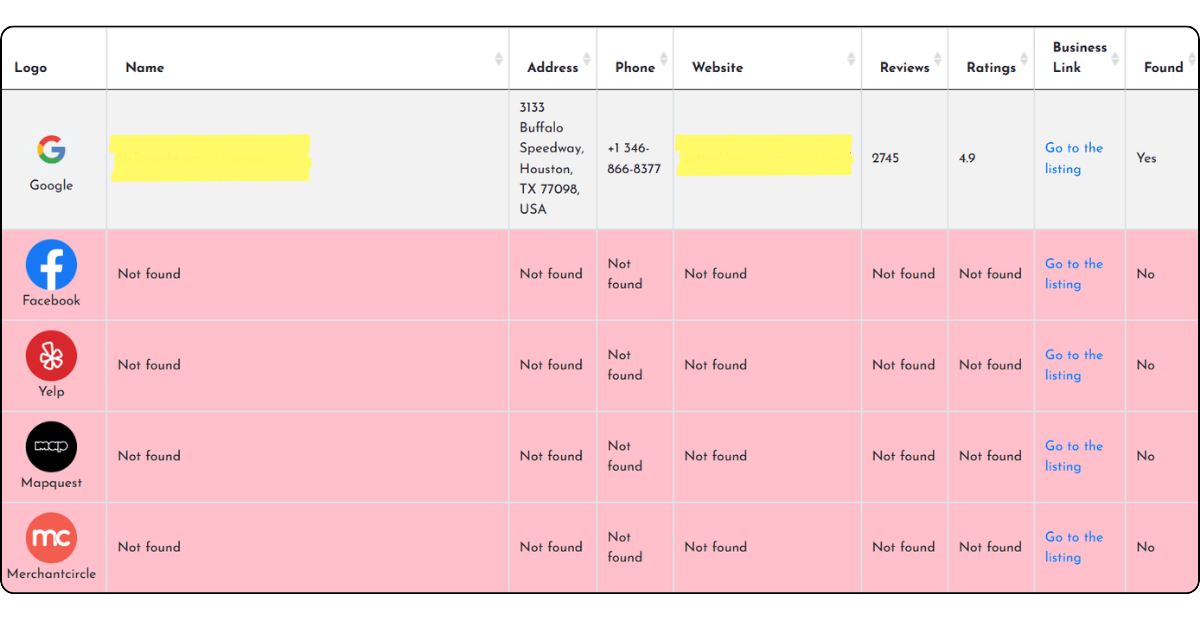
If you are a service area business and do not serve customers at your address, follow the GBP rules. Do not publish an address just to look local.
Business Listing and Citations
A citation/listing is a mention of your business name, address and phone number on a third-party website, like a directory or an industry association. They help confirm you are a real business operating where you say you are.
Do not buy packages of 300 listings. 20 high quality & accurate ones on sites people actually use are worth more than hundreds of automated entries.
Backlinks
A backlink is a link from another website to yours, and quality links help Google find your pages and judge whether other people take trust you.
For a moving company the links that count is mostly local: your chamber of commerce, local news coverage, the real estate agents and property managers who refer you, storage facilities you partner with, suppliers, and anything you sponsor locally.
Be careful with mass guest posting and press release distribution. Both are named in Google’s link spam policies, so recommending them alongside “do not buy links” is an illogicality. And do not buy bulk link packages.
Reviews
Reviews feed the prominence part of Google’s local ranking, and they are the single biggest factor in whether someone calls you after finding you.
What matters is the pattern, not the number. Never buy reviews or offer discounts for them. Google’s policies prohibit it and the filters catch it.
Terms About AI Search and Answer Engines
AEO
AEO means answer engine optimization. It matters now because people ask ChatGPT, Perplexity and Google’s AI features the same questions they used to type into a search box.
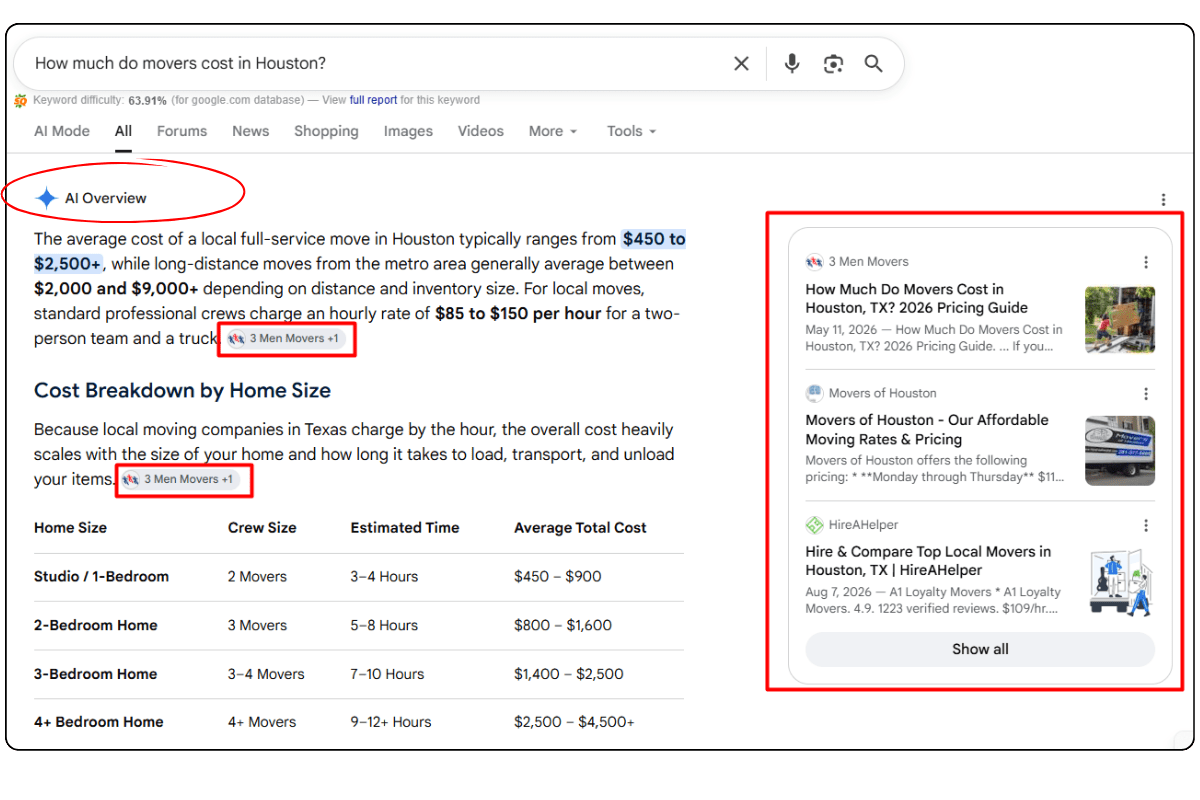
AI systems read your page, find the part that answers the question, and cite you in the answer. Use headings that say what the section covers. Answer the question in your first sentence, then explain.
Write “[Your Company Name] charges” instead of “we charge”, because a machine reading one paragraph out of context does not know who “we” is.
GEO
GEO means generative engine optimization. It is the same idea as AEO, aimed at whether AI tools mention your company when someone asks for a recommendation.
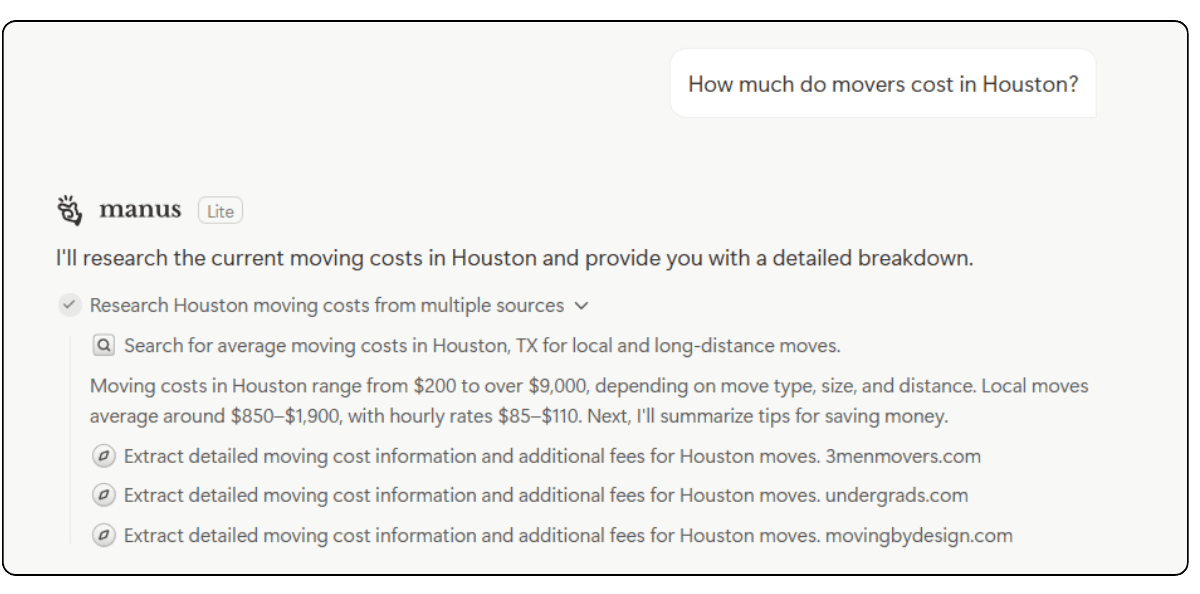
An AI tool recommends you when enough independent sources agree that you exist and do good work. Your website is one source. Your Google Business Profile, your reviews and third-party listings are the others.
An AI tool recommends you when enough sources agree that you exist. Your website is one of the main source then Google Business and other sites
That is why GEO is mostly the same work as the rest of this guide. Clear pages, accurate listings, real proof, and reputation.
Being mentioned does not mean being clicked, and being clicked does not mean being hired. We explain that gap in why your AI visibility score is misleading.
AI Overviews and AI Mode
AI Overviews and AI Mode are Google Search features where Google writes an answer at the top and links to the pages it used.
On 3 June 2026, Google added Search Generative AI performance reports to Search Console. You can finally see how often your pages appear in these AI answers. It shows impressions only for now, with no click data. Save a screenshot of your starting numbers when you get access, because there is no history before you look.
The report started rolling out to a subset of site owners in the UK first, with a global rollout planned but no confirmed date, so it may not be in your account yet. And the data starts on 18 May 2026 with no history before that, so screenshot your starting numbers the day you get access.
The same update added a control that lets you block your content from AI Overviews, AI Mode and Discover AI.
llms.txt
An llms.txt file is a text file you put on your website that points AI tools toward your best pages. Google’s guidance says no special file or markup is required to appear in AI Overviews or AI Mode. So keep it for other AI tools.
Terms About Results Tracking
Conversion
A conversion is any action you want a visitor to take: a phone call, a form submission, a WhatsApp message, a quote request.
Conversion tracking measures those actions and records where each one started. That is what tells you which pages bring in real enquiries and which ones just collect traffic.
Conversion Rate Optimization (CRO)
Conversion rate optimization (CRO) is the work of improving the current visitor’s quality of your website.
For example, for movers the usual wins are more calls and form submissions by adding service comparison and pricing table.
Google Analytics (GA4)
GA4 is the latest version of Google Analytics, and it maps the entire customer path so you can track users, set up events, and mark the important ones as key events.
Create an event for each action that counts as a lead, then mark the important ones as key events under Admin > Data display > Events.
Track phone clicks, WhatsApp clicks and quote form submissions separately. Rolling them into one “contact” event gives you a total and hides which channel produced it.
Search Console
Google Search Console is free too, and it covers the half of the picture GA4 cannot see. GA4 starts measuring once someone lands on your site. Search Console shows you what happened before that: which queries you appeared for, how many people saw you, and how many clicked.
Use it to spot pages that pull impressions but no clicks, since that usually means your title and meta description aren’t earning the click. It also flags indexing problems. Before you wonder why a page gets no traffic, check whether Google has indexed it at all.
Geo-Grid
A geo-grid checks your local rankings from many points across an area instead of from a single address. The result is a map of color-coded pins. Green means you’re in the top three, yellow means page one but outside it, and red means you don’t show up at all. It’s the quickest way to see how far your visibility reaches before it drops off.
Bottom Line
Mastering the language of Search Engine Optimization is not about transforming into a digital marketing expert overnight; rather, it is about taking strategic control of your moving company’s online presence. By understanding these core terms you effectively bridge the gap between simply paying for services and investing in a measurable strategy that generates high-quality leads.

Mandeep Singh is a Digital Marketing consultant at Strivers Edge, renowned for driving first-page Google rankings for businesses in competitive industries. With more than 10 years in the industry, he specializes in digital and content marketing.